AI Visibility: Technical Implementation Guide
By Fae Esparza, Start Solutions AI
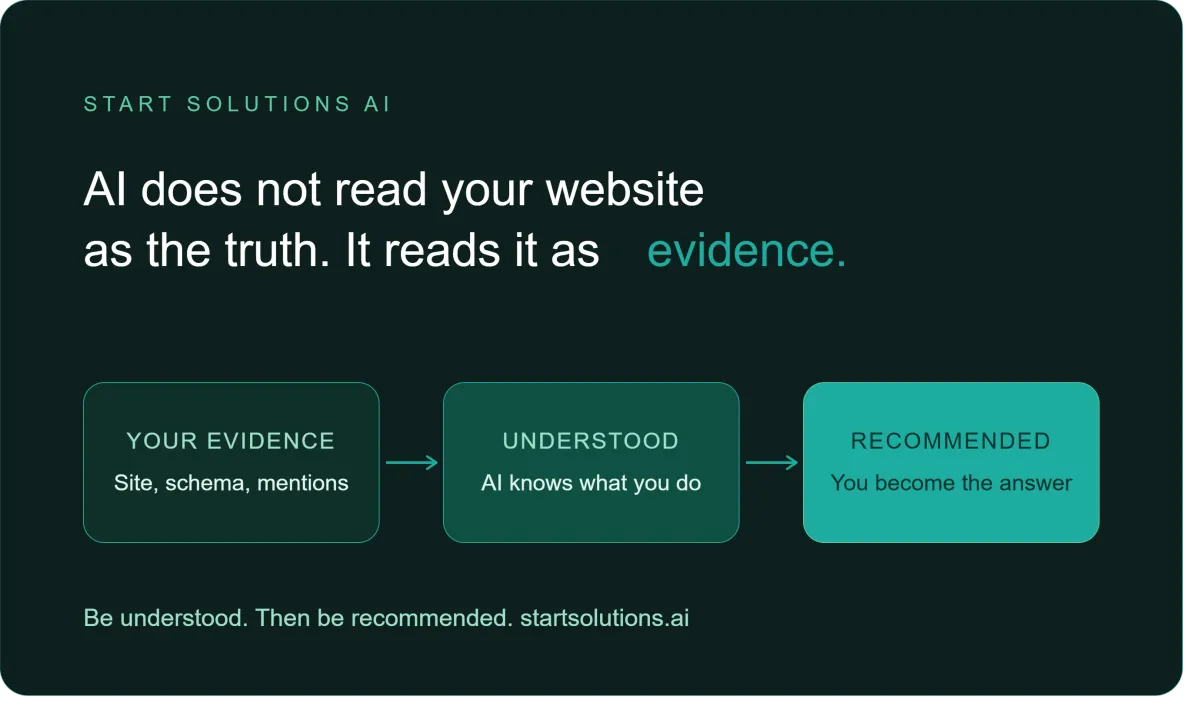
Most AI visibility problems are not marketing problems. They are implementation problems. An AI platform cannot recommend a business it cannot parse, cannot crawl, or cannot reconcile against a coherent set of entity signals. This is the layer where the work either holds or falls apart, and it is the layer most agencies skip.
Start Solutions AI runs technical AI implementation as a defined engagement for engineering teams. Schema and structured data, API readiness, crawlability, and the entity signals that let ChatGPT, Gemini, Perplexity, Google AI Mode, and Copilot understand what a site actually represents. This page describes the service, the process, and the timelines, so your team can scope it against a sprint instead of a sales call.
Who this is for
This is a technical AI visibility service built for CTOs, engineering leads, and the developers who own the codebase. If your content and positioning are already strong but AI platforms still describe you incorrectly, omit you from category answers, or cite a competitor in your place, the gap is usually structural. The signals AI systems rely on are missing, malformed, or contradicted somewhere in the stack.
You do not need to understand entity optimization to work with us. You need to be able to merge a pull request, adjust a template, and expose a few endpoints. We handle the reasoning about what AI systems need. Your team handles the parts that touch production, or we work alongside them.
What technical AI implementation covers
Developer-led AI visibility implementation concentrates on four areas. Each one addresses a specific failure mode we see when we audit sites.
Structured data implementation. Schema is how you tell a machine what a page means rather than how it looks. We implement and validate JSON-LD for the entity types that matter to your business: Organization, Person, Service, Product, FAQ, Article, and the relationships between them. The goal of structured data implementation is not a green checkmark in a validator. It is a consistent, machine-readable description of who you are, what you do, who you serve, and why you are credible, expressed the same way everywhere a machine looks.
API readiness. AI platforms and the crawlers behind them consume data differently than a browser does. We assess whether your content is reachable without client-side rendering, whether your key data is available in clean responses rather than buried in scripts, and whether your endpoints return stable, parseable output. Where a knowledge feed, sitemap index, or structured content API strengthens machine understanding, we specify it and help your team ship it.
Crawlability fixes. A surprising share of visibility loss traces back to a crawler never reaching the page. We review robots directives, render behavior, status codes, redirect chains, canonical logic, and how AI-specific user agents are treated at the edge or CDN. If GPTBot, Google-Extended, PerplexityBot, or ClaudeBot are blocked or throttled without intent, we find it and give your team the exact change to make.
Entity signal alignment. Beyond any single page, AI systems build a model of your business by reconciling signals across your site and the wider web. We check that your naming, descriptions, identifiers, and relationships agree with each other. Contradiction is the quiet killer of AI recommendations. When a platform cannot resolve which version of a business is correct, it tends to omit rather than guess.
The process
We run this as a phased engagement. Each phase produces a concrete artifact your team can act on, so you are never waiting on a black box.
Phase 1: Technical audit. We inspect the current state across all four areas above, using rendering tests, crawl simulation, schema validation, and log or edge behavior where available. The output is a prioritized findings document that separates what is blocking machine understanding from what is merely suboptimal. No guesswork, no generic checklist.
Phase 2: Implementation specification. We translate findings into a build spec written for developers: the schema to add, the endpoints to expose, the crawl rules to change, and the acceptance criteria for each. This is where technical onboarding happens. We align with your stack, your framework, and your deployment process so the work fits how your team already ships.
Phase 3: Build and integration. Your developers implement against the spec, or we pair with them. We stay available for the ambiguous cases, review pull requests against the acceptance criteria, and adjust the spec when reality on the ground differs from the audit.
Phase 4: Validation. We confirm schema parses correctly, crawlers reach what they should, endpoints return what they promise, and entity signals agree across the site. Validation is evidence-based. We show what changed and how machines now read it, not a claim that it is done.
Phase 5: Monitoring handoff. We set up the measurement that tells you whether AI platforms are understanding the business more accurately over time, and we document the technical decisions so the next engineer inherits context instead of mystery.
Timelines
Timelines depend on site complexity, stack, and how much your team implements versus how much we do. As a working baseline:
| Phase | Typical duration |
|---|---|
| Technical audit | 5 to 7 business days |
| Implementation specification | 3 to 5 business days |
| Build and integration | 1 to 3 sprints, depending on scope |
| Validation | 3 to 5 business days |
| Monitoring handoff | 2 to 3 business days |
A focused engagement on a single site with a cooperative dev team commonly runs three to five weeks end to end. Larger properties, multi-domain entities, or heavy build work extend from there. We scope the build phase against your actual backlog rather than a fixed number, because pretending otherwise helps no one.
What you get
At the close of the engagement you have validated structured data across your priority templates, crawl access confirmed for the AI agents that matter, endpoints and feeds that expose your content cleanly, entity signals that agree with each other, and documentation your team can maintain without us. The point is leverage. We build systems your engineers can own, not a dependency on our calendar.
Start here
AI recommendations are the outcome. Entity understanding is the foundation, and that foundation is built in code. If your team is ready to close the gap between what your site says and what AI systems can actually read, book a technical audit and we will show you where the signal is breaking down.
Start Solutions AI helps businesses strengthen the signals that help AI understand, trust, and recommend them.
For a lower-commitment first step, consider trying the free AI Visibility Snapshot from Start Solutions AI alongside the technical audit.