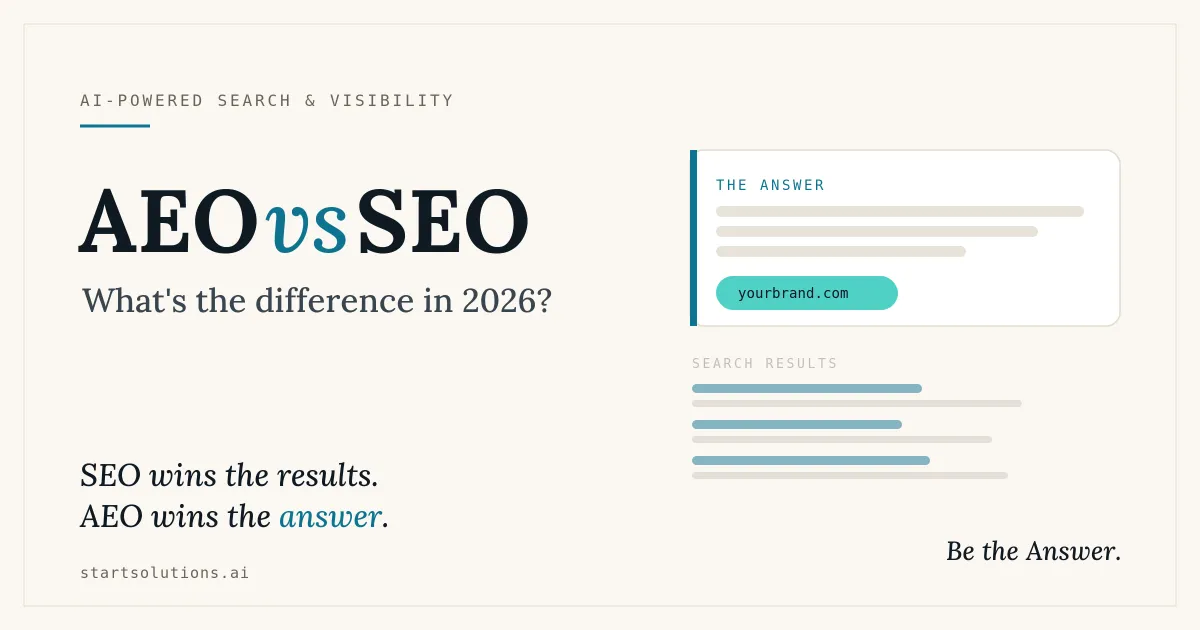
AEO vs SEO: What's the Difference in 2026?
AEO vs SEO in 2026: What Changed and Why You Need Both
Buyers used to find vendors by scanning a page of Google links. Many now start somewhere else. They ask an AI tool a question, read the answer it writes back, and only click once they already have a shortlist.
That change is the whole difference between SEO and AEO. The answer now arrives before the click. Everything in this article follows from that one shift.
This is not a story about one method replacing the other. You still need both. But they are no longer the same job, and treating them as one is how a business ends up ranking well while going unmentioned in the answers its buyers actually read.
The short version
SEO gets you ranked. AEO gets you recommended.
Search Engine Optimization is the older discipline and still the base layer. It makes your site clear and trustworthy to a search engine so your pages rank for the right queries. That means clean technical health, a structure search engines can crawl, sensible internal links, content that matches what people are looking for, and enough outside trust to rank with confidence. The goal is a high position and the click that comes with it.
Answer Engine Optimization has a different goal. It gets your business understood, quoted, and recommended by the tools that now answer questions directly: ChatGPT, Perplexity, Google's AI Overviews, Gemini, and Claude. The win is not a spot on the results page. It is being named in the answer itself, before the user clicks anything.
Here is the catch most teams miss. A page can rank in the top few results and still never show up in the AI summary of that same topic. Ranking earns you a place on the page. Getting named in the answer is a separate result with its own rules.
Why this is happening now
The reason to care about AEO is not that AI is trendy. It is that buyer behavior has moved fast, and the numbers are clear.
Traffic moved first. Adobe Analytics found that visits from AI tools to US retail sites jumped about 1,200% in early 2025 compared with the previous summer. Adobe also found that roughly four in ten US consumers had already used a generative tool while shopping. Research that used to happen across ten open tabs is collapsing into one conversation.
Clicks changed next. Seer Interactive studied thousands of queries and found that when an AI Overview appeared, organic click-through dropped 61% and paid click-through dropped 68%. Ahrefs looked at the top spot specifically and found the first organic result loses about 58% of its clicks when an Overview is present. Pew Research found that when a summary showed up, people clicked a normal link only 8% of the time, about half the rate they click on plain results.
And more searches now end with no click at all. Similarweb found these zero-click searches rose from 56% to 69% in the year after Overviews launched. The results page is becoming a place people stop, not a doorway they pass through.
None of this means SEO is dead. It means the value is moving. Being first matters less when the box above you has already answered the question. The good news is in the same research. Seer found that brands quoted inside an Overview earned about 35% more organic clicks than before. The traffic did not disappear. It went to whoever the AI named. That is the entire business case for AEO.
What AI has to understand before it recommends you
Before any tool recommends a business, it has to understand that business well enough to put its name forward. This is the step most teams skip, and it is what Start Solutions AI is built around.
A model answers four quiet questions using the signals it finds across the web. Who is this business? What does it do? Who does it serve? Why should anyone trust it? When those signals are clear and consistent everywhere the model looks, it has something solid to work with and will use your name. When the signals are thin or contradict each other, the model leaves you out of the answer even if your pages rank well.
Those signals are what we call entity understanding. They are the foundation under everything else. Recommendations are the outcome. Entity clarity is what produces them. Plenty of businesses are known to a search engine. Far fewer are understood clearly enough to be recommended by AI, and that gap is the opportunity right now.
Why an answer page is written differently
A page built to rank and a page built to be quoted are not opposites, but they are not the same either.
A ranking page is usually built around a target query, with supporting topics woven in and a call to action after the scroll. All of that still helps. A page built to be quoted keeps those basics and adds one thing: content a model can lift cleanly. That means a plain definition near the top, a clear claim with no hedging, a short table that settles a question at a glance, and wording precise enough that the AI can repeat it without guessing what you meant.
This is why many sites with solid SEO still underperform in AI answers. Their pages rank because they are relevant and trusted. They go unquoted because they never answer sharply. They were built to collect visits, not to be quoted. The difference looks like this:
Ranking-first page Answer-first page Built for Position and the click Being quoted and named Measured by Rankings, sessions, conversions Citations, AI mentions, referral traffic Reads like A place to explore A source a model can quote Wins when It satisfies a browsing reader It settles the question cleanly
You need both, not one
The question I hear most often is a trade: should we stop paying for SEO and put the budget into AEO? That is the wrong question.
SEO is what makes your site findable and trustworthy in the first place. Answer engines pull heavily from the pages that search engines already rank and rate. Remove the foundation and the answer layer has nothing sturdy to pull from.
The relationship is additive. SEO widens how findable and credible your site is. AEO sharpens how quotable your content is and how clearly you are understood. Run only SEO and you are exposed the moment an AI answer takes the click. Run only AEO and you lack the technical base to hold your position over time. The programs that work treat SEO as the foundation and AEO as the layer on top.
Where you focus first depends on where you are starting:
Weak site, thin organic presence: fix the SEO foundation before you worry about being quoted.
You rank well but Overviews are eating your clicks: move into AEO quickly while protecting what you have.
Research-heavy category with lots of comparison: run both from the start.
You sell on expertise and teaching: lean into AEO, because clear explanation is exactly what answer engines reward.
Where to start
You do not need a big strategy document. You need three things: the questions your buyers ask, the answers AI currently gives, and the pages that deserve to be the answer.
Start by writing down the real questions people ask in the weeks before they choose someone like you. Focus on the commercial ones with intent behind them.
Then ask those questions in ChatGPT, Perplexity, Google's AI Overviews, Gemini, and Claude. Notice two things: who gets named, and how the market gets described when you are not in it.
Next, pick the few pages that should own those answers. Rebuild them to be direct and easy to quote, with a clean definition, a tight summary, and structure a model can lift. Keep the underlying SEO healthy while you do it, since the two support each other.
Finally, track how often you get cited and how much traffic arrives from AI tools, alongside your usual rankings. That tells you whether the market is starting to say your name.
Do only that and you are ahead of most teams still debating whether any of this is real. It is real. The only question is whether you learn it now, while there is room to gain ground, or later, after your traffic has already softened.
How Start Solutions AI approaches it
Our premise is simple. A business needs to be findable in search and understood well enough to be recommended in an answer.
The work pairs technical SEO discipline with the entity signals that tell a model who you are. From there we build the comparison, explainer, and FAQ pages that answer buyer questions directly, then measure the results across organic search, AI citations, and AI-referred traffic.
The pattern we see most is not a shortage of content. It is a structure and consistency problem. Plenty of posts that pull traffic, too few pages built to be quoted, and signals about the business that do not line up from one place to the next. Closing that gap is what turns the expertise a business already has into something AI can actually use.
The fastest way to see your own gap is an AI Visibility Snapshot. It shows where you already appear in AI answers, where you are missing, and which signals are too weak to earn a recommendation, before you decide what to build.
Common questions
In plain terms, what is AEO?
Answer Engine Optimization is the practice of making a business easy for AI tools to understand, trust, and quote when someone asks a question in ChatGPT, Perplexity, Google's AI Overviews, Gemini, or Claude. The goal is to be part of the answer, not just a link near it.
How is that different from SEO?
SEO works to rank your pages and earn the click. AEO works to get you understood and named inside the answer. One competes for a position on the results page. The other competes for a place in the summary that now sits above it.
Does AEO make SEO obsolete?
No. For almost every business, AEO adds to SEO rather than replacing it. Technical health and a clear site structure still drive discoverability and trust, and answer engines rely on the pages those basics produce. AEO builds on that foundation by making your content more quotable and your business easier to understand.
How do I measure AEO?
By how often you get cited, how visible you are across the questions that matter in your category, how much traffic arrives from AI tools, and whether your name appears when a model makes a recommendation. Rankings still count. They are just no longer the whole scoreboard.
Which pages tend to get cited?
Pages that answer a clear question cleanly: comparisons, FAQs, glossaries, honest explainers, and buyer guides with strong summaries and structure. The more directly a page answers a high-intent question, the better its chances of being quoted.
Who should pay attention to this first?
Businesses that sell on expertise in categories where buyers research before they buy. If people compare options, ask real questions, and rely on education before choosing a vendor, AEO is already shaping your funnel whether you are working on it or not.