What Business Owners Get Wrong About Their Own AI Visibility
Two questions come up in almost every conversation I have about AI visibility. The first is whether it matters for a particular kind of business. The second is how anyone would measure it if they wanted to. Both are reasonable, and I have written about both. What sits between them is a third thing nobody asks, because you cannot ask about a gap you do not know is there: whether your sense of how AI systems describe your business is accurate.
It usually is not. I have run visibility snapshots on a few dozen small professional service businesses this summer, mostly owner-operated practices and expertise-led firms. The scores themselves vary the way you would expect. What has been consistent is the direction of the error. Owners are wrong about their own visibility in a specific, repeatable way, and the pattern is worth describing because it changes what you do next.
The assumption is usually "somewhere in the middle"
When I ask an owner to guess before I show them anything, the answer is almost always some version of moderate. Not dominant, because they know they are not the biggest name in their category. Not absent, because they have a real business, a real website, real reviews, and years of work behind them. Somewhere in the middle feels like the safe estimate, and it is the one most people give.
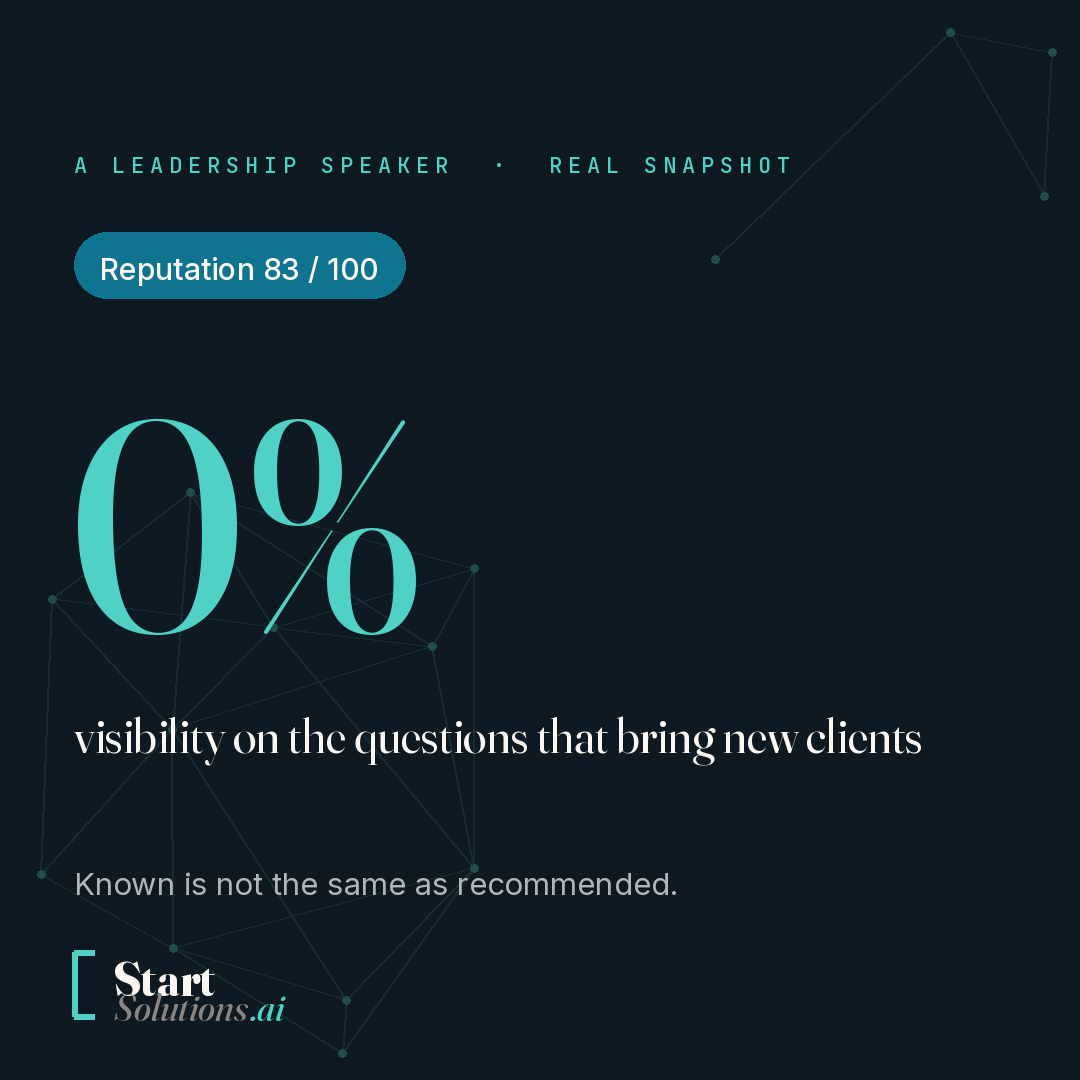
The distribution does not look like that. In the set I have measured, the most common single result is not moderate visibility. It is zero. Not a low score. Zero, on every platform tested, for every query in the scan. Close to half the businesses I have looked at land there. These are not struggling companies. Several have been operating for a decade or more, with strong local reputations and steady referral business.
The second most common result is not moderate either. It is fragmentary: visible on one platform and absent from the rest. Of the businesses in my set that appeared anywhere at all, more than half appeared on two platforms or fewer, and a meaningful number appeared on exactly one. Middle-of-the-pack visibility, evenly spread, is the rarest outcome of the three.
So the honest summary is that most owners are guessing toward the middle of a distribution that is mostly at the ends. That is worth knowing before you decide how much this matters to you.
Checking one assistant is not a measurement
The natural response to reading something like this is to open ChatGPT and ask it about your own business. I understand the impulse and I have no objection to it, but the result will mislead you in one direction or the other, and you will not know which.
This is the part of my earlier article on measurement that I would now put more weight on. The platforms do not agree. In my set, one business scored full coverage on Google's AI Mode and returned nothing at all on ChatGPT. Another appeared on ChatGPT and nowhere else. A third surfaced only on Copilot. The overall rate at which each platform names a small business is broadly similar, within about sixteen percentage points from the most generous to the least, but the businesses they name are not the same businesses. Similar rates with poor overlap means the platforms are drawing on different sources, not applying different thresholds to the same picture.
The practical consequence is that a single check tells you about one platform on one day. If it comes back positive you may conclude you are fine when you are invisible to four systems out of five. If it comes back empty you may conclude you are invisible when you are actually the top recommendation somewhere you did not look. Neither conclusion is available from one query, and both get acted on regularly.
A good sentiment score can mean nothing at all
This is the finding I did not expect and the one I would most want an owner to understand before they buy any tool in this category.
Most visibility tools, mine included, report a sentiment score alongside a visibility score. The sentiment number describes how positively the subject is discussed. In my set, sentiment sits in the seventies for almost everyone. The businesses that no platform can name average around 72. The businesses that do surface average around 77. Five points apart, on a scale where the entire population falls between 37 and 84.
Read carelessly, a 74 sentiment score sounds like AI systems think well of you. What it usually means, for a business with no visibility, is that the topic gets discussed in a positive tone and you are not in the discussion. The score is measuring the answer, not you, because you are not in the answer. It is the single most reassuring number on a report that has nothing reassuring in it, and it is the number I have to walk people back from most often.
If you are evaluating this work, for me or for anyone, that is a fair question to ask directly: what exactly is this number measuring, and does it still return a value when my business does not appear? If it does, treat it as context rather than performance.
Which businesses this actually hits
I wrote recently about which industries benefit most from answer engine optimization, and the pattern in the measurements matches that argument more closely than I expected it to.
The businesses landing at zero in my set are concentrated where you would predict from the theory: expertise-led practices whose credibility lives mostly in the owner's head and in the relationships they have built, rather than in documented, third-party-corroborated form. A practice with a decade of excellent word of mouth and a thin published footprint is exactly the profile that performs well in the real world and disappears in an AI answer. The systems cannot corroborate what has never been written down anywhere they can read.
The contrast that makes this concrete is what happens when you run the same scan on a large national brand in the same category. They surface on every platform, at high coverage, consistently. The difference is not that they are better at the work. It is that there is far more third-party material about them for the systems to draw on. That reframes the problem usefully. Invisibility here is not a technology problem or a website problem. It is a corroboration problem, and corroboration is something you can go build.
What to do with this
I am not going to tell you the fix is fast, because I do not have enough measured time on the other side of it to claim that honestly. What I can say is that knowing which of the three positions you are in changes what you should do first, and that the three call for different work.
If you are at zero across the board, the problem is upstream of tactics. There is not enough documented, independently verifiable material about your business for the systems to draw on, and adding pages to your own website does not solve it, because a site talking about itself is the weakest form of evidence available. The work is third-party corroboration and documented expertise attached to a person.
If you are visible on one platform and absent elsewhere, something you have done is working and it is only reaching one set of sources. That is a more encouraging position than it looks, and the useful move is to find out what that platform is citing about you and whether the same material can reach the others.
If you are visible across several platforms but described inaccurately, that is an identity problem rather than a coverage problem, and it is generally the most fixable of the three.
The common thread is that none of these are visible from the outside, and none of them are visible from one query typed into one assistant. You have to actually look, across platforms, at questions your customers would really ask. That is not a difficult thing to do. It is just a thing almost nobody has done yet, which is most of why the results keep surprising people.
I am continuing to measure this across a larger set and will publish what the numbers look like at scale, including the parts that complicate the story. If you want to know where your own business sits before then, that is what the snapshot is for.