Wave 1 Ran on September 10. It Measures Something Different, and I Am Telling You Before the Numbers Do.
Two weeks ago I published the first results of the Platform Divergence Study: 36 businesses, five AI platforms, and a finding that 17 of the 36 were named by none of them. I also wrote that the study would go longitudinal, with every business re-measured inside a single day, on a fixed monthly schedule, so that what looked like platform disagreement could be separated from drift over time.
Wave 1 ran on September 10. All 36 businesses and all three national controls returned data. Nothing errored. Here is what it measures, what changed in the instrument between the two reads, and why the headline number from the first article does not, and cannot, reappear in this one.
The instrument changed under us
The first read, Wave 0, came from a scan pipeline that asks buyer-intent questions by topic and records whether a business is named at all. It covered ChatGPT, Gemini, Perplexity, Copilot, and Google AI Mode.
Wave 1 runs through a prompt simulator, because that is the route that can re-measure 39 domains in one day. When I validated that route in August it returned four platforms: ChatGPT, Gemini, Perplexity, and Grok. Before running Wave 1, I probed it again rather than assuming. It now returns ChatGPT, Gemini, Perplexity, and Google AI Mode. Grok is rejected outright. Copilot is accepted in the request and silently dropped from the run.
So the platform set changed in one month without anyone announcing it. I had already written, in a caption scheduled for this week, that the series covers Grok. That caption was wrong. The text was corrected before it posted; the image card that ran with it still said Grok, and this article is the correction of record. The lesson is small and specific: the platform set is verified before every wave, from the run itself, not from the settings page. The settings page still lists six platforms. The run returns four.
Why 47 percent does not reproduce, and why that is not good news
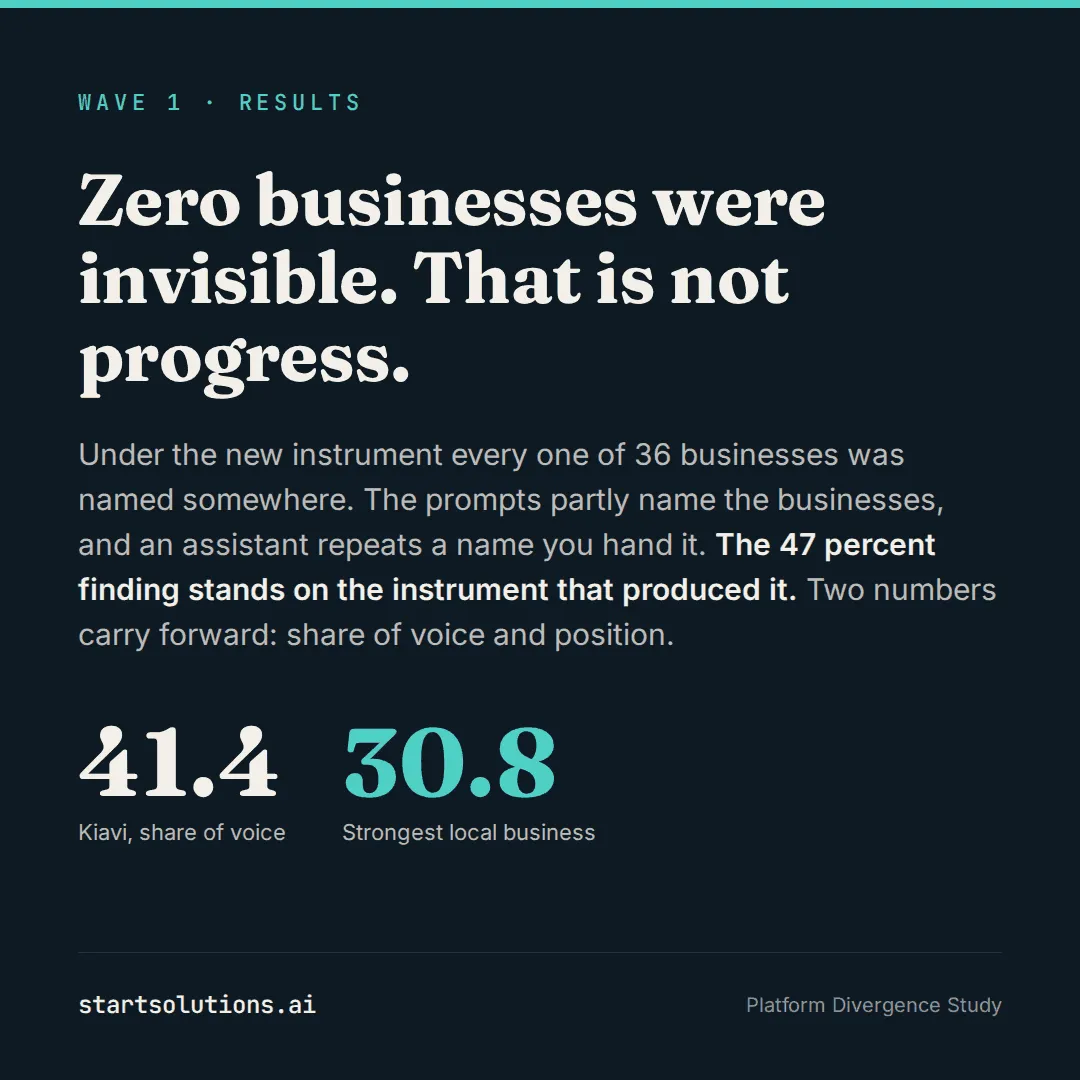
The prompt simulator works from each business's monitored query set. About one prompt per topic names the business directly: is this firm good for this, this firm versus that competitor. When a prompt contains the business name, the assistant almost always names it back.
The consequence is exactly what you would expect. Under this instrument, zero businesses returned zero mentions. Zero were visible on exactly one platform. Thirty-one of 36 were named on all four platforms.
That is not improvement. It is a different question. Wave 0 asked "when a buyer describes what they need, does the machine name you?" Wave 1, with brand-named prompts in the mix, partly asks "when someone types your name, does the machine repeat it?" The second question is nearly always answered yes, and it tells a business owner almost nothing.
I am stating this in print because the alternative is a chart next month showing every business "visible" and a reader concluding the problem went away. It did not. The 47 percent finding stands on the instrument that produced it. It just does not carry into this series.
What does carry: share of voice and position
Two numbers from the simulator do hold up wave over wave, and those are the columns the series will track.
Share of voice is the business's slice of all the businesses the assistants named across its prompts. Position is where it appeared in the answer when it was named.
The national controls still lead, as they did in Wave 0. Kiavi holds 41.4 percent share of voice, BiggerPockets 39.7, Visio Lending 24.1. Established national brands are named first and most, on every platform, because the machines can verify them from many sources.
The strongest local business in the sample, a dental practice, holds 30.8 percent, above one of the three national controls. I read that cautiously; brand-named prompts lift local numbers. But it establishes the ceiling a well-corroborated local business can reach on this instrument, and it is the first number in the series that a future wave can move against.
Across the 36, share of voice runs from under 1 percent to that 30.8. The median is just under 15. Position, when named, clusters near the top of the answer: 30 of the 36 average between 1.0 and 1.5. The exceptions are informative. One software company averages position 2.3 with share of voice of 9.2; it gets named, but behind others, on every platform. That is the profile of a business the machines know about and do not prefer.
One business, two instruments, one lesson
One CPA in the sample is also a client, measured monthly under our own client instrument. That instrument asks ten questions on five platforms and records the answers word for word. Seven of the ten are buyer questions that never mention the firm's name. The measurement taken the week before Wave 1 found Google AI Mode naming the firm on four of those seven, first on one, and Copilot recommending it on none of the seven.
Under Wave 1, the same firm shows 4 of 4 platforms, share of voice 13.6, average position 1.8. Read alone, that looks fine. Read against the client instrument, it is the same firm that Microsoft's assistant will not recommend, because the index Copilot reads had never been handed the site directly and was working from filings and directories instead. Two instruments, two pictures, one business. The buyer-question instrument is the one that matches what a prospect experiences; the simulator is the one that scales to 39 domains in a day. The study needs both, and it will report both, labeled.
Cost, honestly
I budgeted this series against a credit balance and expected each wave to consume roughly 2,360 prompt-by-platform runs. The balance before and after Wave 1 was identical. Either the simulator is not billed against that balance, or billing posts late. I do not yet know which. I will read the balance again at Wave 2 and report the real number when I have it. Until then the per-wave cost is unconfirmed, not zero.
What Wave 1 can and cannot claim
It can claim a clean four-platform baseline, dated to one day, with share of voice and position for 36 businesses and three controls, reproducible from the logged instrument.
It cannot restate the 47 percent finding. It cannot claim Grok coverage. It cannot yet claim movement, because there is nothing before it on this instrument to move from.
Wave 2 runs October 10. That is the first day the series can say what moved, what stayed, and how fast. If nothing moved, I will publish that. A study that reports stability is still reporting.
Wave 0 and the method are in the first article: We Checked 36 Businesses on Five AI Platforms. The Platforms Barely Agree. If you want to know what the assistants say when a buyer asks for someone like you, without your name in the prompt, the first snapshot is free and uses that instrument: startsolutions.ai.