Monthly AI Visibility Reporting
By Fae Esparza, Start Solutions AI
Most businesses find out they lost recommendation share by accident. Traffic looks flat, rankings look fine, and the phone is quieter. Nothing in a traditional dashboard explains why, because traditional dashboards only see what happens after a click. AI answers often end the conversation before the click exists.
Monthly AI visibility reporting exists to close that blind spot. It tracks whether AI platforms mention a business, how prominently, and in what context, measured the same way every cycle so movement means something.
Key Takeaways
- Start Solutions AI tracks AI visibility across ChatGPT, Perplexity, Gemini, and Google AI Mode on a monthly cycle.
- Each platform uses different retrieval signals. Appearing in one engine does not mean appearing in the others.
- Without a baseline snapshot, no measurement that follows has a reference point.
- Query consistency is what separates trend data from noise. Change the questions, and the comparison is worthless.
- Reporting is only useful when it explains cause, not just movement.
What has to exist before you can track anything
Three things, in order.
A baseline snapshot. This captures how AI engines currently discover, understand, and represent a business before any optimization work begins. Start Solutions AI builds it by testing the real questions prospective clients ask, not invented keyword variations. This is a baseline, not a verdict. It is the reference point every later measurement compares against.
A defined platform scope. ChatGPT, Perplexity, Gemini, and Google AI Mode. Each retrieves and cites differently. A business that shows up strongly in Perplexity can be entirely absent from Gemini, and the reason usually sits in the entity signals, not the content volume.
A working understanding of the discipline. Improving AI visibility falls under Answer Engine Optimization (AEO) and Generative Engine Optimization (GEO). These frameworks shape every content and authority decision that follows. Skipping this step tends to produce activity rather than movement.
Why traditional SEO dashboards do not transfer
Rankings, organic traffic, and click-through rate all measure post-click behavior. They are structurally blind to what happens inside an AI answer.
A business can lose recommendation share for an entire quarter with no measurable drop in organic traffic. The queries still resolve. Someone else is just the answer now. A purpose-built AI visibility dashboard captures the signals that precede the click, and the recommendation itself.
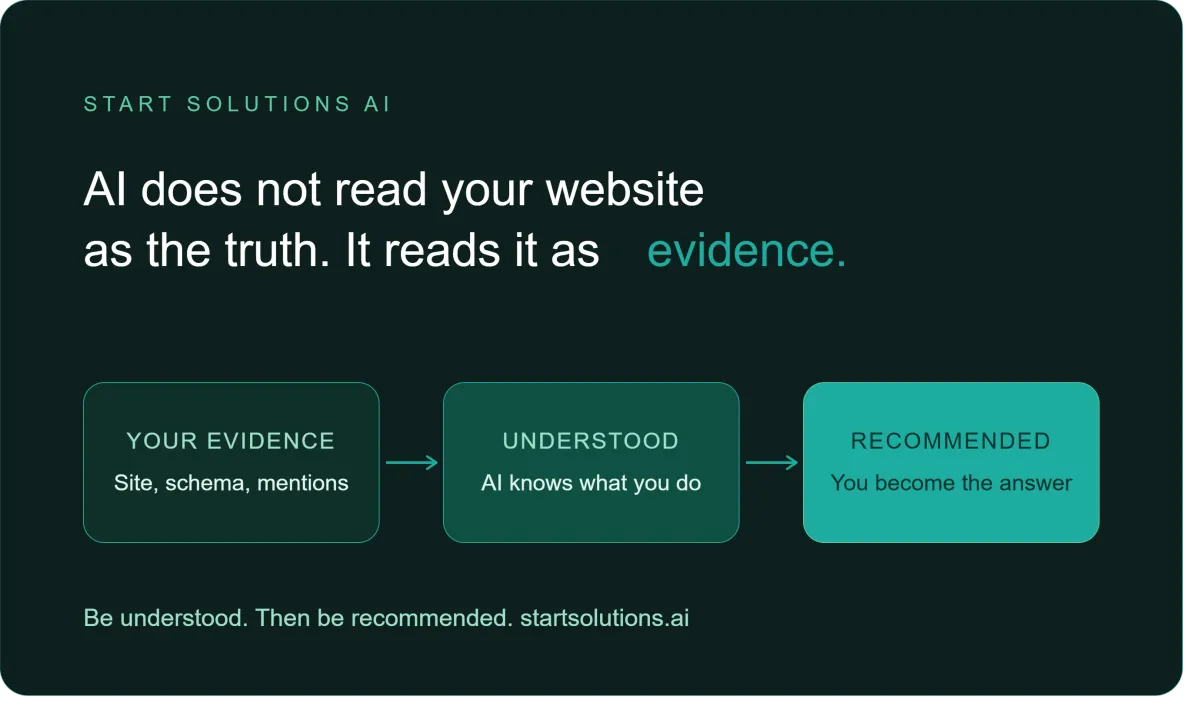
There is also a prerequisite most dashboards ignore. AI engines have to discover a business, understand it, and trust it before recommending it. Structured content and authority signals are not optional dashboard inputs. They are the raw material the dashboard measures. A dashboard tracking a business with weak entity signals will accurately report that nothing is happening.
How do you run a reliable monthly AI visibility report?
Monthly AI visibility reporting requires tracking consistent metrics across the same AI platforms every cycle. Without that consistency, trend data becomes noise rather than signal.
Reporting on AI visibility is harder than reporting on organic rankings. Signals are distributed across multiple platforms, making a structured, repeatable process essential.
What steps does a reliable monthly AI visibility report follow?
- Pull the prior month's snapshot. Open the previous cycle's recorded results before running any new queries, having that reference on hand keeps comparisons precise and consistent.
- Run the established query set. Execute the same topic prompts and questions used at baseline across ChatGPT, Perplexity, Gemini, and Google's AI, so cycle-over-cycle movement is attributable to real change, not query drift.
- Record presence, prominence, and context. For each platform, note whether the brand appears, how early in the response it surfaces, and whether the framing is accurate and favorable.
- Quantify the delta. Calculate the change in mention frequency, citation count, and topic association accuracy versus the prior month to surface meaningful trends rather than isolated observations.
- Identify the cause of movement. Tie gains or losses to specific content or authority-building actions taken during the cycle, this turns the report from a scorecard into an actionable brief.
- Flag operational readiness. Assess whether the business can handle the increased attention that follows stronger AI visibility, discoverability without capacity creates missed opportunities.
- Audit current AI presence. Establish a baseline snapshot by querying major AI engines, ChatGPT, Gemini, Perplexity, and Google's AI, to record where the business is mentioned, cited, or absent.
- Define core AI visibility metrics. Select the AI visibility metrics that matter: mention frequency, citation source quality, topic association accuracy, and competitive share of AI-generated answers.
- Centralize data into one view. Consolidate platform-level data into a single dashboard that stakeholders can interpret and act on each month without requiring technical expertise.
- Schedule monthly reporting cycles. Establish a consistent monthly AI visibility reporting cadence so changes in AI engine behavior are detected and addressed promptly.
FAQ
Which AI platforms does Start Solutions AI track each month?
ChatGPT, Perplexity, Gemini, and Google AI Mode, every month. Each platform uses different retrieval signals, so visibility in one does not predict visibility in another.
What is the first step before building an AI visibility dashboard?
A baseline snapshot capturing how AI engines currently discover, understand, and represent the business before any optimization begins. Without it, later measurements have nothing to compare against.
What disciplines cover the practice of improving AI visibility?
Answer Engine Optimization (AEO) and Generative Engine Optimization (GEO). Both frameworks shape how content and authority-building decisions get made.
How long before monthly reporting shows meaningful change?
It depends on the starting position and on what is being corrected, and any fixed number quoted here would be a guess. The reporting itself produces something usable on the first cycle, because the baseline gives every measurement after it a reference point. Movement in the underlying visibility runs on a different clock. Citation-level changes can surface once a source gets picked up. Entity understanding and trust signals accumulate more slowly, since engines need to encounter consistent information across multiple sources before the representation shifts. Early cycles are usually most valuable for identifying which platform is the constraint, not for demonstrating gains.
The free AI Visibility Snapshot from Start Solutions AI establishes that baseline.