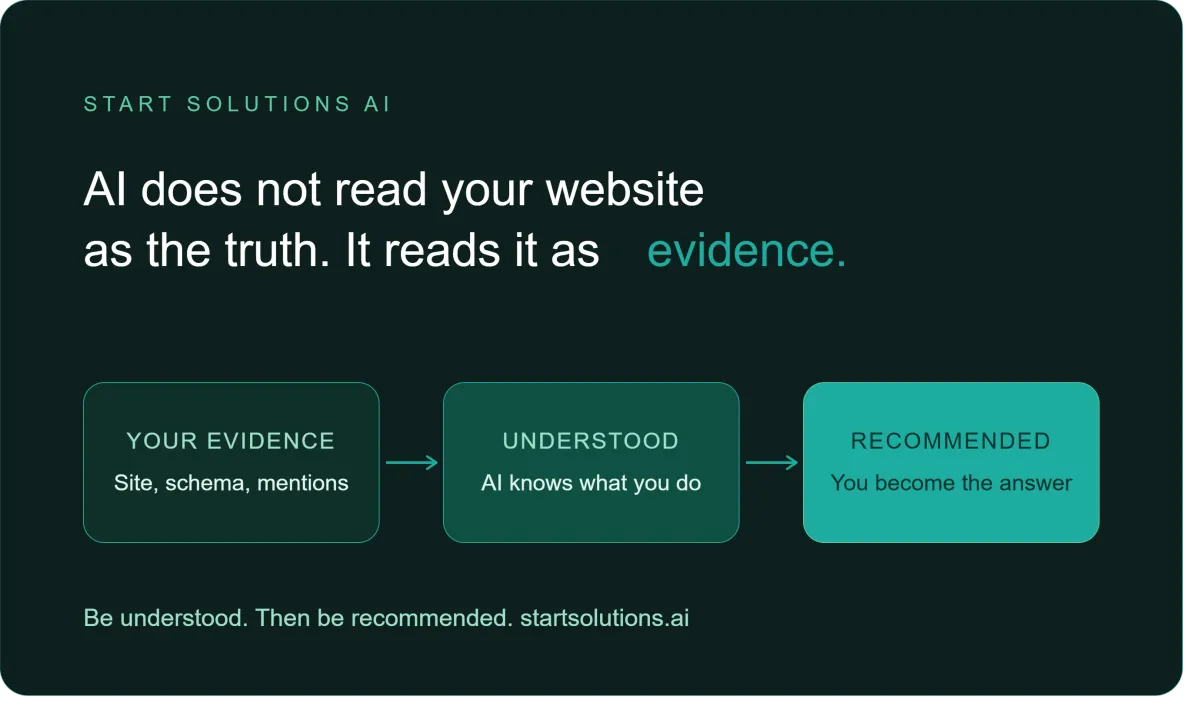
AI Visibility for Financial Advisors
AI Engines Are Recommending Financial Advisors. Is Your Firm on the List?
By Start Solutions AI Editorial Team · Updated July 15, 2026
A quarter of affluent households now begin their advisor search inside ChatGPT or Gemini rather than Google. If those engines don't know who you are, the search ends before you're in it.
AI visibility is the practice of structuring your digital presence so AI platforms surface your firm as a credible, citable source. It's also called Answer Engine Optimization (AEO) or Generative Engine Optimization (GEO). Start Solutions AI measures that presence across ChatGPT, Perplexity, Gemini, and Google's AI, then tracks it monthly so you can see whether it's moving.
Key Takeaways

Start Solutions AI tracks visibility across ChatGPT, Perplexity, Gemini, and Google's AI on a monthly cadence.
25% of affluent households planning to hire an advisor say they'll start that search with an AI tool (Wealthtender, 2025).
AI engines must clear three gates before naming you: discovery, understanding, and trust. Most advisor sites clear none of them.
Optimization without a baseline is guesswork. Measure first.
Why Advisors Are Invisible to AI Engines

Search algorithms used to decide which advisors got seen. AI engines decide now, and they decide differently. A search engine returns a list and lets the consumer sort it out. An AI engine returns an answer, usually naming two or three firms. There is no page two.
Wealthtender's 2025 survey of 500 affluent U.S. households found that 25% planning to hire an advisor will use tools like ChatGPT or Gemini to begin. The same study found 96% of people who receive a personal referral still research that advisor online before making contact. So the exposure runs both directions: AI shapes who gets discovered cold, and it shapes whether a warm referral survives the vetting.
The shift matters because of how these consumers search. They aren't typing "financial advisor near me." They're describing their situation in detail, asking for someone who fits it, and taking the answer at face value.
What an AI Engine Needs Before It Names You

Three things have to be true, in order. Miss any one and the engine moves on to a firm where all three hold.
Discovery. The engine has to find your content in a format it can parse. Most advisor sites are built for human skimming, not machine extraction.
Understanding. Your content has to make the relationships explicit: who you are, whom you serve, what you're credentialed in. AI engines extract entities and relationships. Vague positioning copy gives them nothing to extract.
Trust. Authoritative signals have to connect your name to your topics. Self-published testimonials carry little weight here. Independent third-party sources carry most of it.
These compound. Fixing trust signals for content the engine can't find changes nothing.
Start With a Baseline

Optimization without a starting number can't be evaluated. You won't know whether the work moved anything, and neither will anyone you report to.
A baseline runs the questions your actual prospects ask across each engine and documents whether you appear, in what context, and against whom. That gives you a number to move and, six months on, evidence of whether it moved.
Three technical foundations gate everything downstream:
Structured data on your site, so engines can parse entity relationships instead of guessing at them.
Entity validation. Your name, credentials, and specializations rendered consistently across every digital property. Inconsistency reads as low confidence to an engine deciding whom to cite.
Trust signals from sources the engine already treats as authoritative.
Building Visibility, Step by Step
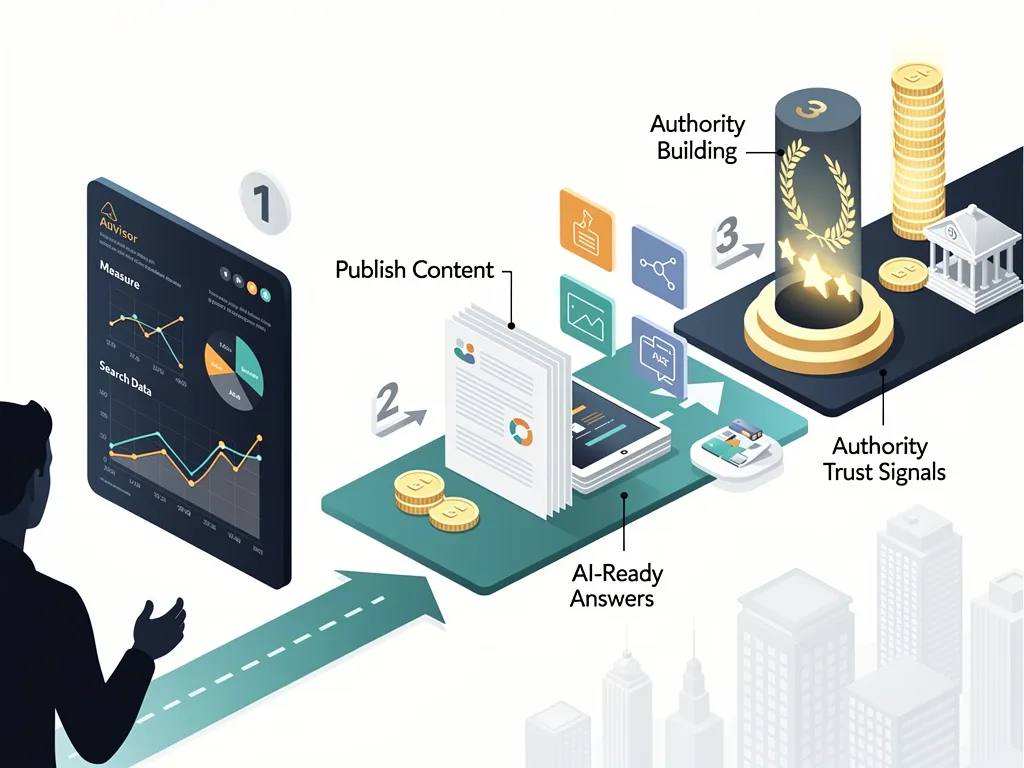
Measure. Baseline across ChatGPT, Gemini, Perplexity, and Copilot. Without it, nothing that follows is provable.
Rewrite the core pages. Home, About, and Services. Restructure them so an engine can extract who you are and why you're credible. Thin copy is invisible copy.
Build third-party authority. Independent reviews and citations on external platforms. These outweigh anything you publish about yourself.
Publish consistently. Structured, AI-legible content on a real cadence. This is the part most firms skip, which is why it still works.
Prepare operations. Visibility produces inquiries. Know what happens when they arrive.
What Makes Content AI-Legible

AI-optimized content states entity relationships plainly: who the advisor is, whom they serve, what makes them credible. Generic marketing copy fails this because it was written to sound good to a human skimming, not to be extracted by a machine parsing. Those are different jobs.
Cross-platform consistency does the rest. One well-structured page rarely moves an engine. The same claims, consistent across multiple independent sources, do.
Where This Goes

The advisors who are visible in AI answers today mostly got there by accident, through PR or a directory listing that happened to be well structured. That window closes as firms start doing this deliberately.
Start Solutions AI measures where you stand, builds the structure and authority signals that change it, and tracks the result monthly. The first step is knowing your number.
FAQ
What is AI visibility for financial advisors? It's the practice of structuring your digital content so platforms like ChatGPT, Perplexity, and Gemini surface your firm as a credible, citable source. It's also called Answer Engine Optimization (AEO) or Generative Engine Optimization (GEO).
Which AI platforms does Start Solutions AI track? ChatGPT, Perplexity, Gemini, and Google's AI, measured monthly against your baseline.
Where does optimization start? A baseline snapshot. It gives the work direction and gives you a benchmark to measure against later.
How long before visibility changes? It depends on your starting point and how much authority already exists under your name. The baseline is what tells you which of those you're dealing with.
Sources: