AI Visibility: Competitive Benchmarking Guide
By Fae Esparza, Start Solutions AI
You have 4,000 students, a decade of results, and a reputation people vouch for by name. Ask ChatGPT to recommend someone in your field and you may not come up at all. Someone with a thinner track record and a better-structured website will.
That gap is measurable. AI visibility benchmarking measures how often you appear in AI-generated answers relative to whoever is appearing instead, across ChatGPT, Perplexity, Gemini, and Google's AI. Start Solutions AI establishes your baseline, then tracks share of voice, prompt coverage, and topic ownership monthly so the gap becomes a number rather than a suspicion.
Key Takeaways
- Your AI competitors are usually not your real competitors. Benchmarking finds out who's actually taking the answer.
- A visibility score in isolation means nothing. Without a competitive set, you can't tell a real gain from a category-wide lift.
- Offline authority does not transfer automatically. Reputation built through students, stages, and referrals is largely invisible to an AI engine.
- Start Solutions AI tracks all four major platforms monthly, because a single snapshot can't distinguish momentum from noise.
Why Established Experts Get Skipped
Established educators and coaches have an unusual problem. Most businesses with weak AI visibility also have weak actual authority, so the fix is the same fix: build a real reputation. You already did that part. Yours just lives in places an AI engine can't read.
Course platforms. Private communities. Student results shared in DMs. Conference stages. Podcast guest spots that were never transcribed. Every one of those built your standing with humans and contributed close to nothing to the machine-readable record. Meanwhile a competitor with a fraction of your experience published forty structured articles and got cited.
This is why benchmarking matters more for you than for a business starting from zero. Your problem isn't that you lack authority. It's that you can't see who's collecting the credit for the thing you're actually best at.
Your AI Competitors Aren't Who You Think
This is the finding that surprises most clients.
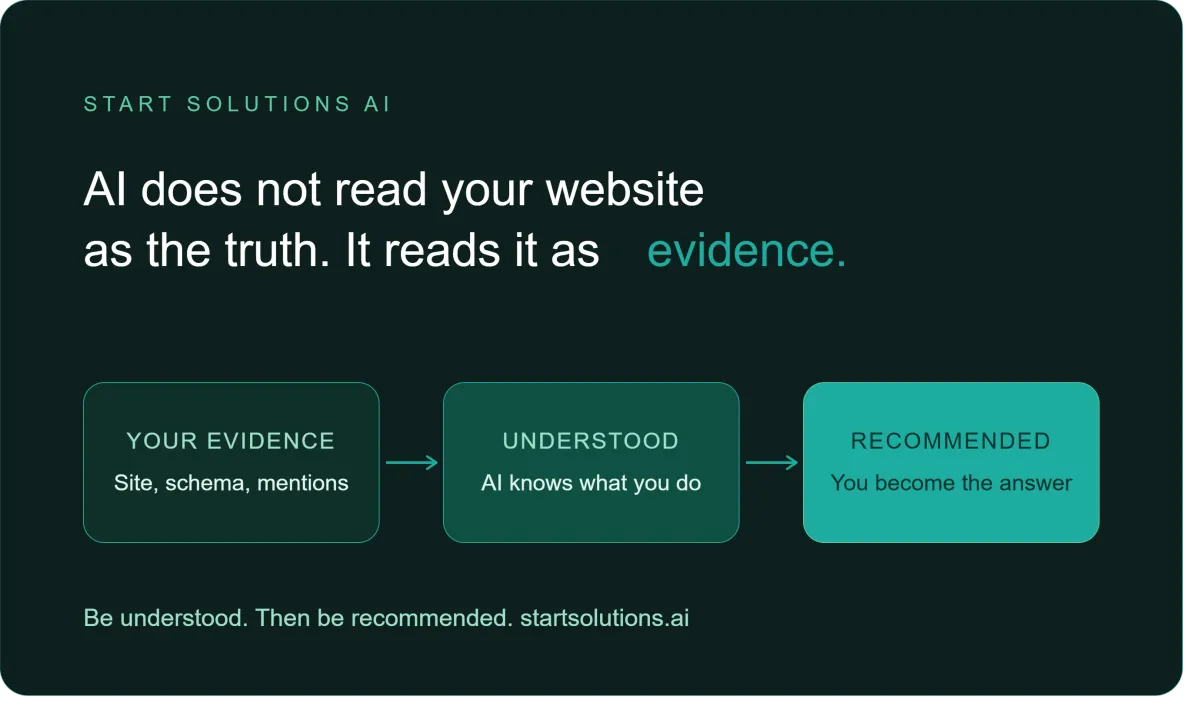
Ask an engine to recommend a real estate investing educator and the names it returns are frequently not the people you compete with for students. They're aggregator sites, listicles, a well-optimized newcomer, sometimes a brand that doesn't even sell what you sell. The engine isn't ranking practitioners by merit. It's assembling an answer from the sources it can parse and trust.
So the first move in benchmarking isn't measuring yourself against a list you wrote from memory. It's finding out who the engines already name. That list is the competitive set. It's almost never the list you'd have guessed, and optimizing against the wrong one wastes the entire effort.
What to Measure
Five dimensions, tracked across every platform. Skipping one leaves a blind spot.
Competitive set. Who the engines currently name for your topics. Discovered, not assumed.
Share of voice. How often each name appears across the same prompt set on each platform. Platforms diverge more than people expect. Strong presence in Perplexity tells you little about ChatGPT.
Prompt coverage. Which of the questions your prospects actually ask return you at all. Coverage gaps are usually more actionable than share gaps, because appearing at zero on a high-intent prompt is a clearer fix than moving from third to second.
Cited sources. Which pages the engine drew from when it built the answer. This tells you what to influence. Often it isn't your site at all, which is the point.
Sentiment. Whether you're described more or less favorably than the alternatives. Being mentioned dismissively is not the same as being mentioned.
The Process
Establish the baseline before anything else. Without a starting measurement you cannot verify that any subsequent work did something, and you can't separate your improvement from the whole category rising.
- Discover the competitive set. Run the real questions your prospects ask and record who gets named.
- Run query-level analysis. Find the specific prompts and topics where others own the answer, and the ones nobody owns yet. Unclaimed prompts are the cheapest wins available.
- Measure share of voice across all four platforms on an identical prompt set.
- Audit sentiment against the competitive set.
- Track monthly. A competitor gaining ground over 60 days is invisible in a one-time audit and obvious in a trend line.
Closing the Gap
Benchmarking tells you where you stand. It doesn't move anything by itself. What moves the number:
Make your existing authority legible. This is the highest-leverage step for established experts and the one most often skipped. Your track record, credentials, student outcomes, and speaking history need to exist in structured, crawlable, citable form. Most of it currently doesn't. You aren't building authority here. You're transcribing it.
Target the prompts you lost. Publish against the specific queries the benchmark flagged, not against a generic content calendar.
Build third-party citations. Independent sources carry weight that self-published claims don't. This is where offline reputation can be converted, if you go get it documented.
Re-measure. Monthly, against the same prompt set, or you've learned nothing.
The baseline described here is what the free AI Visibility Snapshot from Start Solutions AI provides.
FAQ
What platforms does Start Solutions AI track?
ChatGPT, Perplexity, Gemini, and Google's AI, measured monthly against your baseline on a consistent prompt set.
What comes first?
The baseline snapshot. Without a starting measurement, improvements can't be verified and your gains can't be separated from category-wide trends.
Why is benchmarking different for educators than for other businesses?
Most businesses with low AI visibility also have low actual authority. Established educators have the opposite problem: real authority that lives in formats AI engines can't read. The work is conversion, not construction.
What disciplines does this fall under?
Answer Engine Optimization (AEO) and Generative Engine Optimization (GEO). The framing matters because it determines which signals get prioritized.